
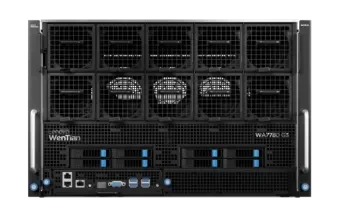
The Lenovo WenTian WA7780 G3 server hosts the full DeepSeek-R1/V3 671B model on a single machine, serving concurrent users smoothly with 768GB of GPU memory — below the 1TB commonly treated as the industry baseline — which is enough for an organization of a thousand people and gives enterprises a new reference point for large-model deployment.
Breaking through performance limits: a new baseline for DeepSeek-R1 deployment
DeepSeek is drawing worldwide attention and many enterprises are preparing local deployments. In practice they face key decisions: can the full DeepSeek R1 run on a single machine? What is the minimum configuration? How do you keep a good experience under high concurrency and throughput? How do you avoid buying the wrong hardware?
Lenovo's breakthrough gives enterprises a more scientific basis for selection. With 1TB of GPU memory widely accepted as the baseline for hundred-billion-parameter models, Lenovo's engineering team raised memory utilization substantially through expert-parallel optimization, an upgraded intelligent memory-access architecture and a PCIe 5.0 full-interconnect design.
Lenovo reports that the WA7780 G3 already deployed the full DeepSeek 671B R1 and V3 models on 768GB of GPU memory in early February, meeting the concurrency needs of small and medium businesses. Memory-access optimization and expert-parallel scheduling on the Lenovo heterogeneous AI computing platform then increased single-machine concurrency tenfold within a month and improved per-user TPOT, TTFT and overall experience.
Continuous optimization for user experience
The result adds a new dimension to hardware selection and reminds buyers to evaluate test data carefully instead of chasing raw throughput and total concurrency. Start from user experience and look at what sits behind those numbers, such as data precision: moving from FP8 to int8 or int4 (quantization) clearly improves benchmarks — higher concurrency and throughput — but sacrifices accuracy, which is usually not what users want.
High throughput and high concurrency do not equal a good experience either. When GPU cards are modest, local communication bottlenecks can add latency and degrade the experience — one of the difficulties Lenovo set out to solve.
The breakthrough removes a major bottleneck for large-model adoption in enterprises. Going forward, Lenovo's Infrastructure Solutions Group and the Lenovo Research ICI Lab will keep working together, using the Lenovo heterogeneous AI computing platform to optimize the full DeepSeek pipeline — AI pre-training, post-training and inference — delivering better-performing, more cost-effective products and solutions.