
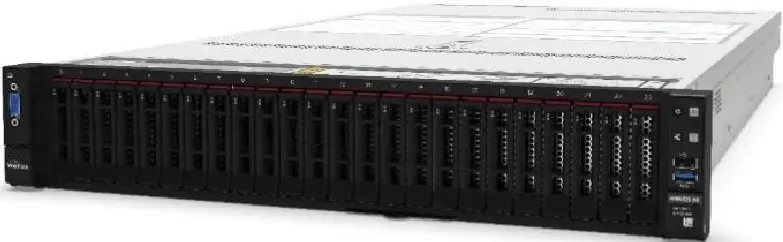
Lenovo has launched its first AMD-based WenTian server, bringing powerful compute to the intelligent transformation of industries across China. The Lenovo WenTian WR5225 G3 is a high-performance 2U2S rack server that carries on Lenovo's “three highs and one low” server design and adds five major advances: double the CPU core count, 25% higher AI workload performance, double the I/O bandwidth, double the cooling capacity and 50% higher customization efficiency.
As the newest member of the WenTian family, which stands for local innovation plus agile efficiency, the Lenovo WenTian WR5225 G3 is the first in the line to use AMD processors, which have earned a strong reputation in data centers in recent years. With the latest 4th Gen AMD EPYC processors, the WR5225 G3 reaches a new level in core counts, cache capacity and other performance metrics, as well as in energy efficiency and market fit.
Strong performance for both general and growing AI compute needs
General-purpose rack servers carry the mainstream workloads of most enterprises and public institutions in internet, finance, manufacturing, telecom and education in China today. As business grows, so do their requirements for compute infrastructure. With 4th Gen AMD EPYC processors, the WR5225 G3 doubles cores per processor, supports 256 CPU cores per system and delivers a 2.8x performance jump.
As generative AI and large models spread, demand for AI compute keeps climbing across industries. The WR5225 G3 is optimized for AI work: it supports up to 8 single-width LP GPUs or 4 double-width GPUs, raising AI workload performance by 25%.
Flexible expansion for changing business requirements
The WR5225 G3 shows notable scalability: memory, PCIe and NVMe bandwidth and slot counts all rise clearly over the previous generation, giving it an edge in HPC, virtualization, simulation and design, big data computing, high-frequency trading, EDA, image processing and AI inference.
A breakthrough multi-zone layout delivers strong scalability. Based on a patented design, 12 PCIe 5.0 slots double I/O bandwidth. The WR5225 G3 supports up to 24 TruDDR5 memory slots with DDR5 5600MHz/6000MHz and PCIe 5.0, and offers multiple flexible drive options for up to 32 NVMe SSDs.
A flexible interconnect mode supports configurations of up to 160 PCIe 5.0 lanes, giving the server strong storage and I/O capability. Customers can choose xGMI high-speed interconnect: for higher CPU-to-CPU performance, four xGMI links can be connected at once; to attach more PCIe devices or NVMe drives, one link can be dedicated to supporting more devices.
Careful engineering keeps the server stable and cool
While servers keep pushing performance and expansion, stability remains a must for customers, and as compute grows, power and cooling become challenges every server has to overcome. Lenovo applied a set of innovative technologies to keep the server steady while achieving higher energy efficiency.
Twin-star decoupled BMC plus the Aegis overload protection system: the decoupled dual-BMC design prevents start-up failures caused by a single BMC fault and enables interruption-free firmware upgrades, cutting downtime and avoiding complex system switching so failover is transparent to users and business continuity holds. The Aegis overload protection system applies defense against multi-point attacks, targeted attacks and proactive prevention to stop PCB overheating from burning the board, effectively preventing overload damage.
Full air-and-liquid cooling coverage for higher efficiency: liquid cooling covers CPU, DIMM, VR and GPU, and the adaptive silicon memory cold plate further raises liquid cooling efficiency. The module uses soft silicon thermal material accurate to 0.01 mm so it fully contacts the DIMMs for fast heat transfer. The WR5225 G3 also uses Lenovo's ram-horn EVAC heatsink, whose biomimetic cat-paw copper heat pipes handle high-power processors, improving CPU cooling efficiency by 50% in testing while freeing internal space for CXL cards or GPUs.
Tornado intelligent airflow control improves reliability: optimized modular, independent airflow control keeps hot air from the CPU heatsinks from raising the intake temperature at the power supplies. In testing it lowers power-supply intake temperature by more than 4°C, improving overall system performance and power supply reliability.
Lenovo will continue to build on its “one horizontal, five vertical” strategy, launching stable and efficient servers, and will focus on AI infrastructure to grow the Lenovo ecosystem. The new server generation keeps “three highs and one low” as its value proposition, refining server design to support the intelligent transformation of customers across industries.